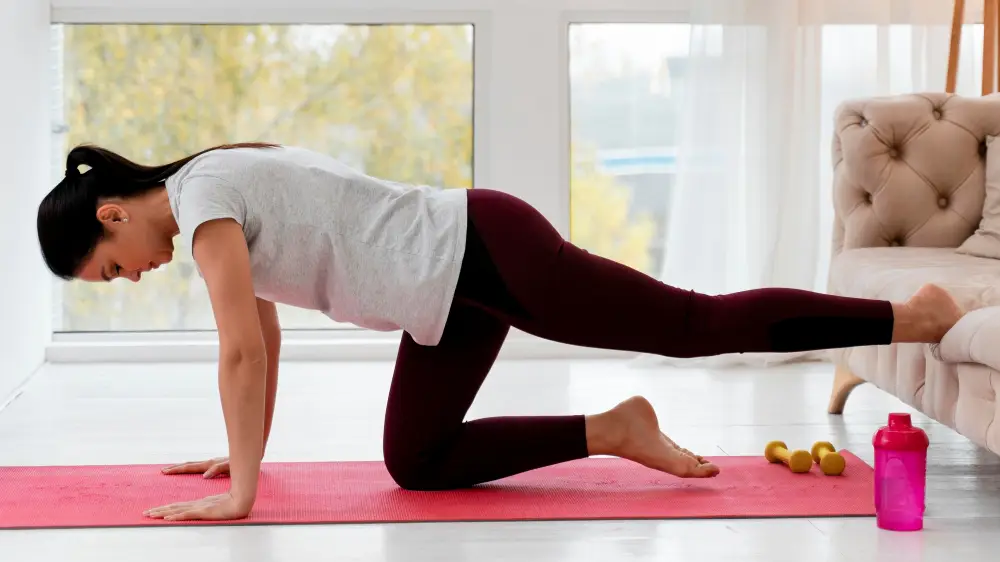
You don’t need a gym membership to get fit. With just your body weight and a little floor space, you can build strength, improve stamina, and burn calories at home. These 30 exercises cover every major muscle group and suit beginners and experienced exercisers alike.
Before you start, warm up for 5 minutes with marching on the spot or arm circles. Stop any exercise that causes sharp pain.
Lower Body Exercises
- Bodyweight squats – Stand with feet hip-width apart, push your hips back, and lower until your thighs are parallel to the floor.
- Forward lunges – Step forward and lower until both knees bend to about 90 degrees. Alternate legs.
- Reverse lunges – Step backward instead of forward. This version is easier on the knees.
- Glute bridges – Lie on your back with knees bent and lift your hips until your body forms a straight line.
- Wall sit – Lean against a wall with knees bent at 90 degrees and hold for 20 to 60 seconds.
- Calf raises – Rise onto your toes, pause, then lower slowly.
- Side lunges – Step wide to one side and bend that knee while keeping the other leg straight.
- Sumo squats – Take a wide stance with toes turned out to target the inner thighs.
Upper Body Exercises
- Push-ups – Keep your body straight from head to heels. Drop to your knees if needed.
- Incline push-ups – Place your hands on a sturdy table or couch to make push-ups easier.
- Tricep dips – Use a stable chair and lower your body by bending your elbows.
- Plank shoulder taps – In a high plank, tap each shoulder with the opposite hand.
- Pike push-ups – Form an upside-down V with your hips high to work the shoulders.
- Superman – Lie face down and lift your arms and legs a few inches off the floor.
- Arm circles – Small and large circles in both directions build shoulder endurance.
Core Exercises
- Plank – Hold a straight line on your forearms for 20 to 60 seconds.
- Side plank – Balance on one forearm with your body sideways.
- Bicycle crunches – Bring opposite elbow to opposite knee in a pedaling motion.
- Dead bug – On your back, lower opposite arm and leg while keeping your lower back flat.
- Leg raises – Lie flat and lift straight legs to 90 degrees, then lower slowly.
- Bird dog – On hands and knees, extend opposite arm and leg and hold briefly.
- Russian twists – Sit with knees bent, lean back slightly, and rotate side to side.
Cardio Exercises
- Jumping jacks – A classic way to raise your heart rate.
- High knees – Run on the spot while lifting knees to hip height.
- Mountain climbers – In a plank, drive your knees toward your chest quickly.
- Burpees – Squat, jump your feet back into a plank, return, and jump up.
- Skaters – Leap side to side, landing on one foot.
- Butt kicks – Jog on the spot, bringing heels toward your glutes.
Mobility and Stretching
- Cat-cow stretch – Alternate arching and rounding your back on hands and knees.
- Hip flexor stretch – Kneel on one knee and gently push your hips forward.
How to Build a Home Workout From These Exercises
Pick one exercise from each group and do it for 30 to 45 seconds, then rest for 15 to 30 seconds. Repeat the circuit 3 or 4 times. Change the exercises every week to keep things interesting.
- Beginners: 2 to 3 sessions a week, 15 to 20 minutes each.
- Intermediate: 3 to 4 sessions a week, 25 to 30 minutes each.
- Advanced: add more rounds, shorter rests, or harder versions like jump squats.
For more ideas, see our list of best home workout ideas.
Tips for Safe Home Workouts
- Focus on good form before speed or extra reps.
- Use a mat on hard floors to protect your joints.
- Drink water before, during, and after exercise.
- Rest at least one day a week to let muscles recover.
Sample Home Workouts Using These Exercises
Not sure how to combine the moves? Here are four ready-made routines. Do each exercise for the time shown, move straight to the next, and rest for 1 minute after each round.
15-minute beginner workout
30 seconds work, 30 seconds rest, 3 rounds:
- Bodyweight squats
- Incline push-ups
- Glute bridges
- Bird dog
- Marching high knees
20-minute fat-burning workout
40 seconds work, 20 seconds rest, 3 rounds:
- Jumping jacks
- Reverse lunges
- Mountain climbers
- Push-ups
- Skaters
- Plank
20-minute strength workout
45 seconds work, 15 seconds rest, 3 rounds:
- Sumo squats
- Pike push-ups
- Side lunges
- Tricep dips
- Superman
- Side plank (each side)
10-minute core finisher
40 seconds work, 20 seconds rest, 2 rounds:
- Dead bug
- Bicycle crunches
- Leg raises
- Russian twists
- Plank shoulder taps
How to Make Bodyweight Exercises Harder
Bodyweight training keeps working as long as you keep challenging your muscles. When an exercise feels easy, try one of these:
- Slow down: take 3 to 4 seconds to lower into each squat or push-up.
- Add a pause: hold the hardest point, such as the bottom of a squat, for 2 seconds.
- Do more reps or rounds: add 2 reps or 1 round each week.
- Cut rest time: reduce rest from 30 seconds to 15 seconds.
- Use harder versions: jump squats instead of squats, full push-ups instead of incline push-ups, or single-leg bridges instead of bridges.
- Add simple weights: a backpack with books, filled water bottles, or a resistance band.
Low-Impact Options for Sore Joints
If you have knee, hip, or back problems, or you live in an apartment and want to avoid noise, swap high-impact moves for gentler ones:
- Jumping jacks: step jacks, stepping one foot out at a time
- Burpees: walk your feet back into a plank instead of jumping
- High knees: marching on the spot with arm swings
- Skaters: side steps with a reach
- Lunges: reverse lunges, which are easier on the knees, or squats to a chair
These still raise your heart rate and build strength, just with less stress on your joints.
A Simple Weekly Home Workout Schedule
- Monday: 20-minute strength workout
- Tuesday: 30-minute walk or 15-minute beginner workout
- Wednesday: 20-minute fat-burning workout
- Thursday: rest or gentle stretching
- Friday: 20-minute strength workout plus core finisher
- Saturday: active fun, such as dancing, cycling, or a long walk
- Sunday: rest
Adjust the plan to your fitness level. Beginners can start with three workouts a week and add more as they get stronger.
Equipment That Helps (But Isn’t Required)
Everything in this guide works with no equipment. If you want to add variety later, these low-cost items are worth considering:
- Exercise mat: cushions your knees and back on hard floors
- Resistance bands: light, cheap, and great for rows and glute work
- Adjustable dumbbells or kettlebell: for progressing squats, lunges, and presses
- Jump rope: an effective cardio tool if you have space
- Doorway pull-up bar: for back and arm strength
Frequently Asked Questions
How long should a home workout be?
Even 15 to 20 minutes can be effective if you work steadily. As you get fitter, increase to 30 to 45 minutes or add more rounds.
Should I do cardio or strength exercises at home?
Both. Strength exercises build muscle and protect bones, while cardio improves heart health and burns calories. The sample workouts above combine them.
Is it okay to exercise at home every day?
Light activity such as walking or stretching is fine daily. For harder workouts, allow at least one rest day a week, and avoid training the same muscles hard two days in a row.
Can I get fit with only home exercises?
Yes. Bodyweight exercises can build strength, stamina, and flexibility. Progress by adding reps, rounds, or harder variations.
How many times a week should I work out at home?
Most adults benefit from at least 150 minutes of moderate activity a week, plus muscle-strengthening work on 2 or more days.
What is the single best exercise to do at home?
There isn’t one. Squats, push-ups, and planks together cover most of the body and make a strong starting point.
Disclaimer: This article is for general information only and is not a substitute for professional medical advice. Always consult a qualified doctor about your health.